
BRD
Document-based AI assistant | UP2DATE case study
UP2DATE case study: an AI assistant connected to a banking knowledge base, using relevant documents to support its answers.
Client / product
BRDWhat we delivered
AI assistant · Knowledge baseWho it is for
Users looking for information in the connected banking materials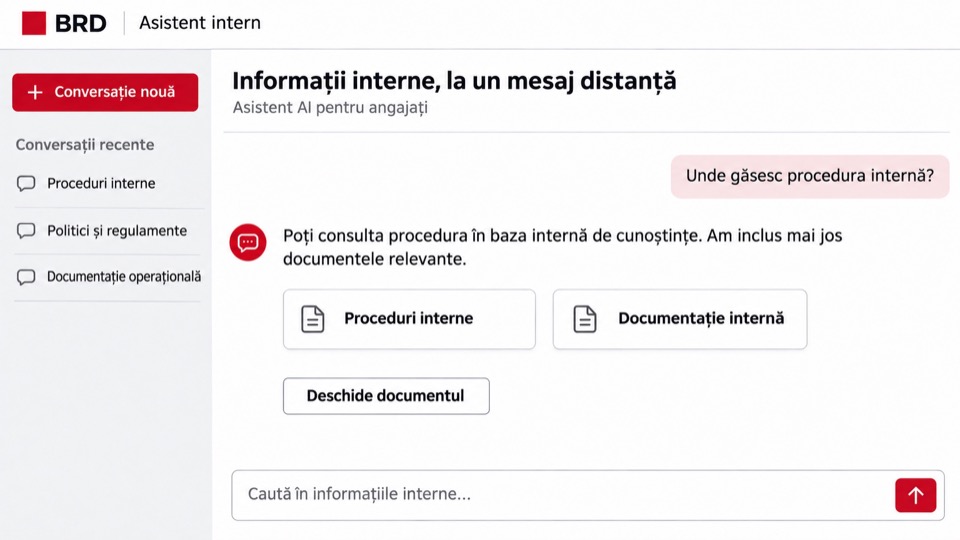
The starting point
Project context and objectives
The BRD project focuses on access to banking information. Materials in the knowledge base provide the context the assistant uses in conversation.
What the solution needed to do
- Access knowledge through natural-language questions.
- Retrieve relevant materials from the connected knowledge base.
- Use documents as context for the answer.
From problem to implementation
The challenges and how we addressed them
A chat interface is useful when it finds information relevant to the question. The challenge is connecting the user’s question, the available documents and the answer produced.
Questions phrased in different ways
Users describe the problem in their own words, while documents use specific structures and terminology.
Our approach
We connected the question to a mechanism for retrieving relevant materials from the knowledge base.
Answers grounded in documents
The model needs the right context to produce a useful answer about the company’s information.
Our approach
Retrieved documents are included in the answer’s context through a RAG workflow.
Understanding the source of an error
An unsatisfactory answer may originate in the retrieved document or the model’s wording.
Our approach
Separating retrieval from answer generation makes it possible to evaluate the information found and the resulting answer independently.
UP2DATE’s contribution
What we implemented
UP2DATE implemented an AI assistant connected to a banking knowledge base. The solution retrieves relevant documents before generating an answer, rather than relying solely on conversation with a general-purpose model.
- The user asks a question.
- The system searches the connected knowledge base for relevant materials.
- The retrieved context is passed on to generate the answer.
This separation between retrieval and answer generation allows two different aspects to be evaluated: whether the right information was found and whether it supports the answer. The workflow describes the published technical contribution; it does not imply a guaranteed accuracy rate or usage volume.
How the solution works
Question
The user submits their request.
Retrieval
The system searches for relevant materials.
Response
The model uses the documents as context.
Solution components
Technologies and their role in the project
From the interface used every day to the data and integrations behind it.


Python · FastAPI
The application service and interfaces for the question-and-answer workflow.
OpenAI GPT-4
Generating answers based on the retrieved context.

Retrieval / RAG · Redis
Information retrieval and caching for workflow components.
What becomes possible
Benefits for users and the organisation
Access through questions
Users can explore the connected knowledge base in natural language.
Context from company materials
Relevant documents inform the answer.
Clearer evaluation
Retrieval and answer generation can be analysed separately. Quality remains dependent on the sources and on validation in use.
Let’s start with your situation
Working on a project in a similar context?
Tell us what you want to improve, who uses the solution and which systems are already in place.